
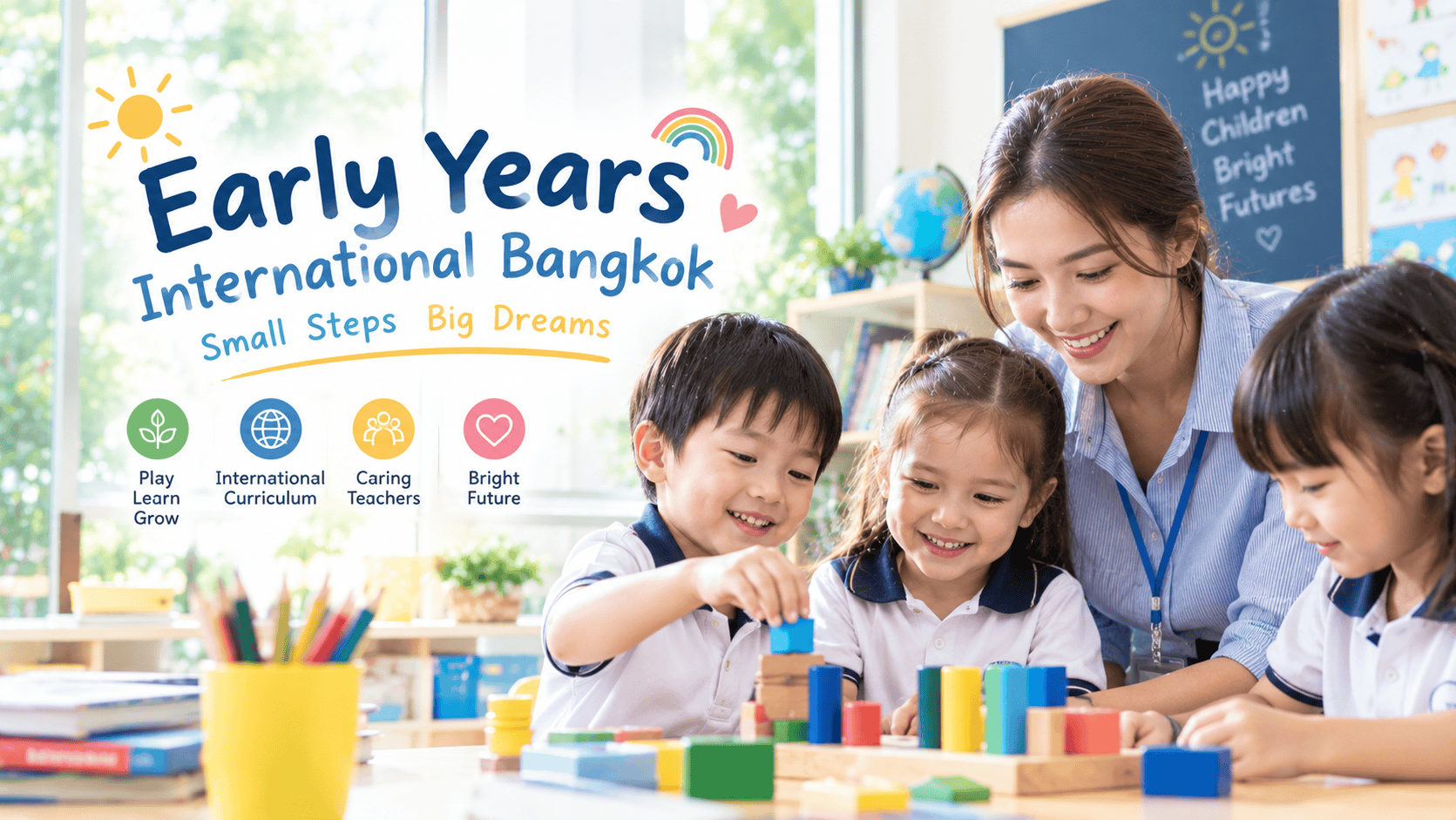
The early years of a child’s life are filled with important discoveries. From learning their first words to forming friendships and solving simple problems, young children develop valuable abilities through everyday experiences. One of the most effective ways to support this growth is through play-based learning.
For parents exploring Early Years International Bangkok programmes, understanding how children learn through play can make choosing an educational environment easier. A quality early childhood programme should provide opportunities for exploration, creativity, communication and social interaction while respecting each child’s individual development.
Rather than treating play as a break from education, modern early years approaches recognise it as an essential part of learning.
What Is Play-Based Learning in Early Childhood Education?
Play-based learning is an educational approach that encourages children to develop knowledge and practical skills through meaningful activities. These experiences may involve imaginative games, building blocks, storytelling, music, outdoor exploration and creative projects.
Children learn naturally when they are curious and engaged. For example, building a tower with blocks introduces basic mathematical concepts, while pretending to run a shop encourages communication and cooperation.
Teachers play an important role by preparing suitable activities, asking thoughtful questions and helping children discover new ideas.
Child-Led Play and Teacher-Guided Activities
Child-led play allows children to choose activities based on their interests. This independence encourages decision-making, creativity and confidence.
Teacher-guided activities introduce specific learning objectives through engaging experiences. A teacher might organise a counting game, demonstrate a science experiment or lead an interactive story.
Combining both approaches creates a learning environment where children can explore freely while receiving appropriate educational support.
Five Essential Skills Children Develop Through Play
Play contributes to several interconnected areas of early childhood development. Although every child develops at a different pace, a stimulating environment can encourage steady progress.
1. Language and Communication
Young children develop communication skills through conversations, storytelling, singing and imaginative games.
When children explain their ideas or describe objects, they practise vocabulary and sentence formation. Group activities also help them understand how to listen, respond and take turns speaking.
In an international nursery environment, regular exposure to English provides additional opportunities to become familiar with new words and expressions.
2. Social Skills and Emotional Understanding
Playing with others teaches children how to share materials, cooperate and understand different perspectives.
They gradually learn that other children may have different preferences, ideas and feelings. These experiences support empathy and positive relationships.
Teachers can guide children through disagreements and encourage them to express emotions appropriately.
Learning how to participate in a group is particularly valuable when preparing for Reception and later school years.
3. Problem-Solving and Critical Thinking
Simple activities often present challenges that encourage children to think independently.
A puzzle requires observation and experimentation. Building a bridge with blocks introduces balance and structure. Sorting objects by colour or size encourages comparison and classification.
These activities help children become comfortable trying different solutions.
Instead of always providing immediate answers, teachers can encourage children to ask questions and investigate possibilities.
4. Physical Development
Movement is an essential part of early childhood learning.
Running, climbing, balancing and dancing contribute to gross motor development. Drawing, threading beads and handling small objects support fine motor coordination.
Both types of movement prepare children for everyday tasks, including dressing independently, using classroom materials and eventually developing handwriting skills.
Safe indoor and outdoor activity areas therefore contribute meaningfully to a well-rounded nursery experience.
5. Creativity and Independence
Creative activities allow children to express their ideas without always following fixed instructions.
Painting, music, role-playing and construction activities encourage imagination and experimentation.
Children also build independence when they select materials, complete simple tasks and take responsibility for their belongings.
Over time, these experiences can strengthen their willingness to try unfamiliar activities.
How the British EYFS Curriculum Supports Learning Through Play
The Early Years Foundation Stage, commonly known as EYFS, is a framework used in England to support children’s learning, development and care.
It recognises seven areas of learning, including communication and language, physical development, personal, social and emotional development, literacy, mathematics, understanding the world, and expressive arts and design.
Play-based experiences can address several areas simultaneously.
For example, preparing imaginary meals in a play kitchen may introduce counting, communication, teamwork and creative thinking within one activity.
Parents considering a British Early Years curriculum in Bangkok can look for schools that connect these areas through purposeful, age-appropriate experiences rather than relying exclusively on worksheets or formal instruction.
What Does an Effective Play-Based Classroom Look Like?
A well-designed early years classroom should invite children to investigate, communicate and experiment.
Different activity zones can encourage different types of learning. Reading corners support early literacy, construction areas develop spatial awareness and art stations promote creativity.
Materials should be accessible and suitable for children’s ages and abilities.
An effective classroom also creates opportunities for children to move between activities without unnecessary restrictions.
Why the Learning Environment Matters
Children are more likely to engage with activities when they feel comfortable and secure.
Natural light, organised learning resources, welcoming teachers and appropriate furniture can help create a positive atmosphere.
Outdoor spaces add valuable opportunities for physical movement, sensory exploration and social play.
Parents visiting a nursery should observe whether children appear interested in their activities and whether teachers respond attentively to individual needs.
How Parents Can Encourage Play-Based Learning at Home
Supporting early childhood development does not require expensive educational materials.
Everyday activities can become meaningful learning opportunities.
Cooking together can introduce counting, measurement and new vocabulary. Reading picture books encourages imagination and listening skills.
Simple household objects can support sorting, building and problem-solving activities when used safely.
Parents can also ask open-ended questions such as “What do you think will happen next?” or “How could we build this differently?”
These conversations encourage children to explain their thinking.
It is equally important to allow time for unstructured play. Children benefit from opportunities to follow their interests without constant adult direction.
Choosing an Early Years International Bangkok Programme
When comparing international early childhood programmes, parents should consider more than academic reputation.
The school’s teaching philosophy, classroom environment, teacher-child interaction and approach to emotional wellbeing all influence the daily learning experience.
A useful starting point is to ask how the programme combines independent exploration with guided educational activities.
Parents should also enquire about communication with families, outdoor learning opportunities and support during the transition into school.
Exploring Brighton College Bangkok Vibhavadi
Brighton College Bangkok Vibhavadi offers an Early Years programme based on the British EYFS framework.
Its approach includes purposeful play, small-group learning experiences and opportunities for children to explore indoor and outdoor learning spaces.
The programme supports children’s development across Pre-Nursery, Nursery and Reception, with age-appropriate experiences intended to encourage curiosity and confidence.
Families researching Early Years International Bangkok can explore the school’s nursery programme to learn more about its teaching approach and learning environment.
Frequently Asked Questions About Play-Based Learning
Is play-based learning suitable for children aged two or three?
Yes. Age-appropriate play provides opportunities for young children to practise movement, communication, social interaction and independent exploration.
Does play-based learning prepare children for academic subjects?
Yes. Games involving sounds, numbers, patterns and storytelling can introduce foundational literacy and mathematics concepts before formal academic instruction becomes more structured.
What should parents look for in an international nursery?
Parents should consider teacher qualifications, safeguarding practices, emotional support, learning facilities, curriculum structure and communication with families.
Can children learn English through play-based activities?
Regular exposure to songs, stories, conversations and interactive activities can help children develop familiarity with English in meaningful contexts.
Conclusion
Play-based learning provides valuable foundations for children’s intellectual, physical, social and emotional development.
By encouraging curiosity, independence and positive relationships, a thoughtful early years programme can help children approach new experiences with confidence.
For families selecting an international nursery in Bangkok, observing how children learn and interact within the classroom is often more informative than focusing on academic outcomes alone.
Choosing an environment where children feel supported, engaged and motivated to explore can provide a positive beginning to their educational journey.